


The future is not humans versus AI. It is systems that help each contribute where they are strongest.
A great deal of the conversation around AI still assumes a false choice.
Either humans remain firmly in control and AI stays narrowly constrained, or AI becomes increasingly capable and human judgment becomes less central. One side dominates. The other recedes.
I don’t think that is the most useful way to understand where we are headed.
The more interesting challenge is not choosing between human dominance and machine dominance. It is designing systems where humans and AI can work together without constantly forcing one to compensate for the other’s weaknesses.
That requires something more deliberate than automation alone.
It requires mutual adaptation.
Not in the sense that humans should endlessly contort themselves around opaque systems, and not in the sense that machines should be asked to intuit what the workflow never made explicit. But in the sense that the surrounding system should be designed so each can contribute where it is strongest, with less friction, less ambiguity, and clearer terms of cooperation.
That, to me, is one of the most important design questions of the next era.
Cooperation is not the same thing as control
Too often, human / AI partnership is framed as a question of control.
Who decides? Who approves? Who gets the final say?
Those questions matter, especially in high-consequence environments. But by themselves, they are not enough.
A workflow can preserve formal human control while still placing people in a weak position. If the system is ambiguous, if the handoffs are unclear, if the AI output is difficult to interpret, and if escalation paths are poorly designed, then the human role becomes reactive rather than empowered. The person may technically remain “in charge,” but in practice they are left monitoring a process they did not shape, correcting failures they could not easily predict, and carrying context the system never held properly.
That is not meaningful cooperation. It is compensation.
Likewise, a workflow can overburden AI by asking it to operate inside conditions that are too semantically unstable to support trustworthy delegation. If terms do not hold consistent meaning, if exceptions are poorly structured, and if the system depends on informal cues humans acquired through experience, then the technology is being asked to act in an environment that has not been made clear enough for action.
That is not partnership either. It is wishful deployment.
Mutual adaptation starts with respecting different strengths
Humans and AI do not contribute in the same way.
That is obvious, but organizations often behave as though the only real question is how much one can substitute for the other. A better question is how the system can make better use of both.
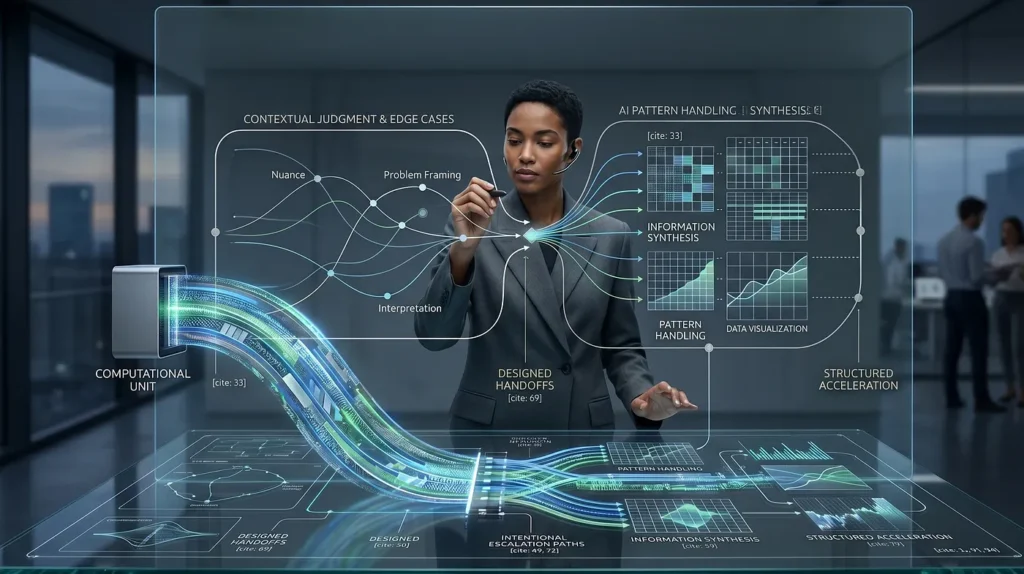
Humans are good at contextual judgment, at noticing when something feels off, at adapting under changing conditions, and at interpreting nuance that has not been fully captured in the structure of the workflow.
AI can be useful in pattern handling, structured acceleration, information synthesis, draft generation, routine routing, and the rapid execution of clearly defined logic.
These strengths are complementary, but only if the system is built to support the handoff between them.
If the workflow leaves too much ambiguity in the structure, humans end up doing constant rescue work. If the system hides uncertainty, people are forced to guess when to trust the output. If escalation paths are vague, everyone spends more time recovering than cooperating. And if AI is inserted into poorly aligned environments, its speed amplifies confusion instead of relieving it.
Mutual adaptation means designing for the relationship, not just the capability.
The system should not force humans to behave like error handlers
In many organizations, the human side of “human in the loop” has become far too narrow.
The human is treated as a reviewer, a checkpoint, or a fallback. In theory, that sounds responsible. In practice, it often means the person is positioned downstream, asked to validate outputs, catch mistakes, and absorb exceptions after the fact.
That is a weak version of human contribution.
People add the most value when they are not trapped in constant cleanup. They are strongest when they can frame problems, evaluate edge cases thoughtfully, notice emerging patterns, and exercise judgment where the situation genuinely calls for interpretation.
If the system is designed well, human oversight becomes more meaningful and less exhausting. If the system is designed poorly, human involvement becomes a form of continuous repair.
One of the jobs of UX in this moment is to help ensure the human role remains substantive rather than merely supervisory.
The system should not ask AI to interpret what the organization has failed to define
On the other side, many organizations are asking AI to work inside environments that remain structurally unclear.
The language is inconsistent. The workflow contains undocumented exceptions. Statuses do not mean the same thing across teams. Context breaks across tools. People know how to make it work because they have lived inside the system long enough to interpret its inconsistencies.
Then AI is introduced and expected to move through that same environment successfully.
This is not a problem of model ambition. It is a problem of system readiness.
We should not expect reliable machine contribution in spaces where the organization has not yet done the work of semantic alignment, workflow clarification, and explicit exception handling.
In other words, AI should not be asked to intuit what the system itself has failed to say clearly.
Mutual adaptation means making the environment more legible for the machine while also making the machine’s behavior more legible for the human.
Both matter.
What good cooperation looks like in practice
If human-AI partnership is going to work well, it needs better operating conditions.
That includes:
Clearer workflow boundaries
People and systems need a shared understanding of where responsibility begins, ends, and escalates.
Stable meaning across the stack
Terms, statuses, and categories need to hold consistent meaning across interfaces, logic, data, and reporting.
Visible uncertainty
AI should not present ambiguity as false confidence. Systems should surface uncertainty in ways humans can interpret and act on.
Designed handoffs
Transitions between human judgment and machine execution should not feel accidental. They should be visible, legible, and recoverable when something goes wrong.
Intentional escalation paths
When the workflow encounters ambiguity, the route back to human judgment should be clear.
Assigning Roles Based on Distinct Strengths
Humans should not spend their time doing what machines can do reliably, and machines should not be trusted with what the system has not made clear enough to delegate.
This is not about protecting humans from AI or limiting AI for its own sake.
It is about shaping the terms of cooperation so each can contribute effectively.
Where business, UX, and prevention can all thrive
This is where I see a real opportunity.
Business wants scale, speed, and measurable value. UX wants systems that reduce friction and support human goals. Prevention focuses on structural clarity before failure becomes expensive.
These do not have to be competing agendas.
In fact, they are more powerful together.
Business benefits when systems are stable enough to support trustworthy delegation. UX contributes by clarifying workflows, reducing ambiguity, and shaping handoffs people can actually use. Prevention contributes by identifying structural weaknesses early, before they become scaled liabilities under automation.
That is not a compromise among competing interests.
It is a shared strategy for building systems that hold.
When these disciplines work together, the result is not simply more humane technology or more efficient technology. It is more resilient technology . Technology that can support both human judgment and machine acceleration without constantly forcing one to clean up after the other.
The future is not domination. It is coordination.
I do not think the most valuable human role in the age of AI is to stand in opposition to the machine. And I do not think the most valuable machine role is to minimize the human.
The deeper opportunity is coordination.
Systems designed for mutual adaptation make better use of both forms of contribution. They reduce preventable friction. They make meaning more stable. They help people apply judgment where it matters most. They help AI operate inside conditions where speed is actually useful rather than destabilizing.
That kind of future will not be built by accident.
It will be built by teams willing to treat cooperation as a design problem, not just a tooling decision.
Because the best human / AI systems are not the ones where one side wins.
They are the ones where both can work well together.
Contact Rocket to discuss how to modernize your current technology with AI.