

As AI makes screens, flows, and code easier to generate, UX returns to its core job: defining problems clearly enough for humans and machines to solve them together.
There is a growing assumption that AI will reduce the need for UX because machines can now generate layouts, flows, and even code faster than ever before. On the surface, that assumption seems reasonable. If AI can produce artifacts in seconds, what is left for UX professionals to do?
I think that framing gets this moment exactly wrong.
AI is not making UX obsolete. It is forcing UX back to basics.
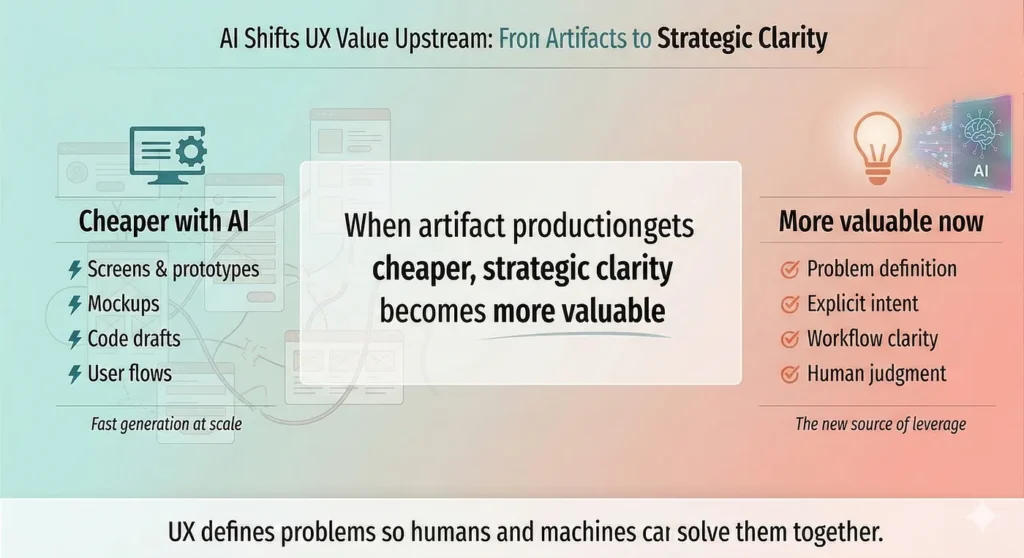
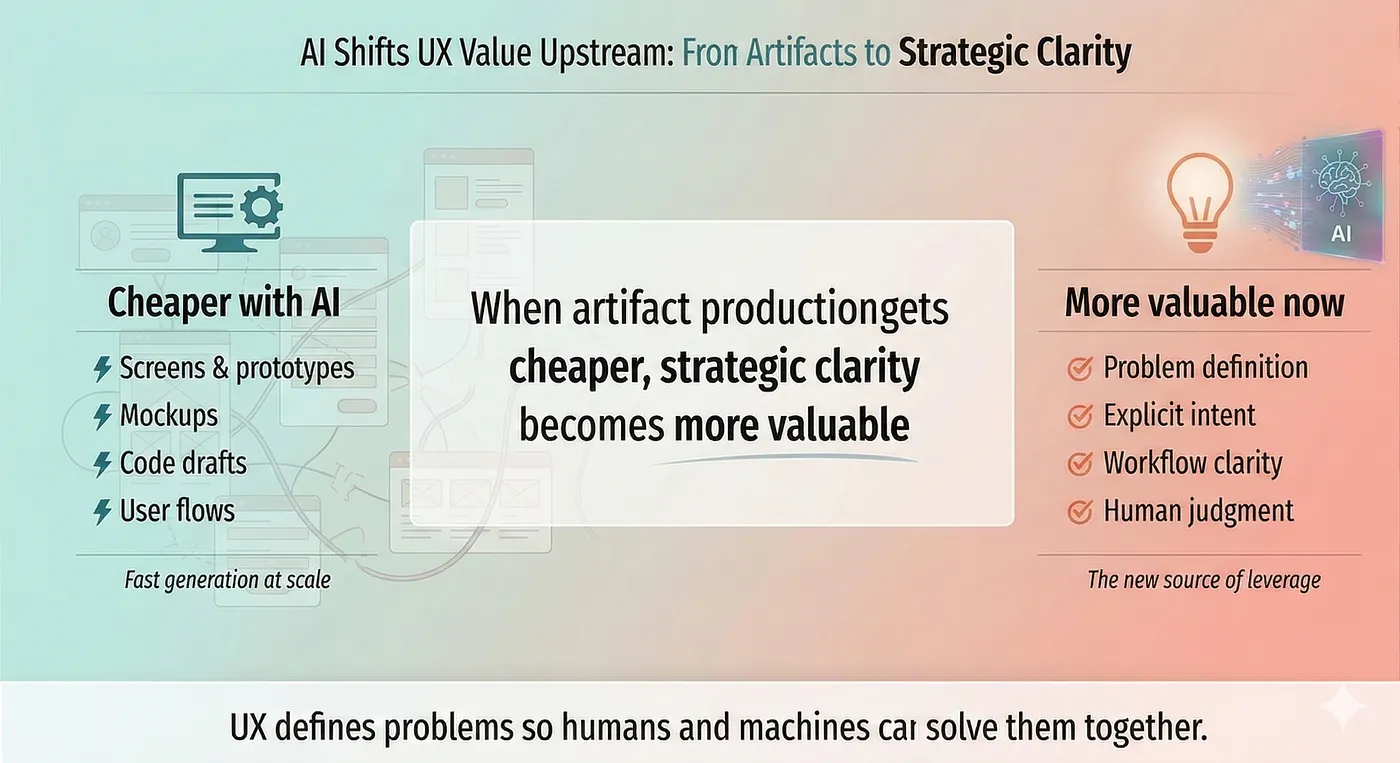
When the production of screens, prototypes, and interface patterns becomes faster and cheaper, the differentiator is no longer the artifact itself. The value moves upstream. It shifts toward identifying the right problem, defining it clearly, making intent explicit, and shaping the conditions for effective action. In other words, it shifts toward the deeper work UX was always meant to do.
For years, many organizations have treated UX as a downstream function. Teams build the architecture, define the logic, and make structural decisions first. Then, at some point, UX is invited in to improve the flow, refine the interface, or make the experience feel more intuitive. That model was always limited. AI simply makes its weakness harder to ignore.
AI is a force multiplier and force multipliers do not just accelerate good decisions. They also accelerate confusion, ambiguity, and poorly defined problems. If the issue itself is misunderstood, AI will not save the team from that mistake. It may simply help them execute the wrong solution faster and with more confidence.
That is why I believe this moment is not just a technology shift. It is a professional refocus. UX now has an opportunity to reclaim its most strategic role: not just shaping what users see, but helping define what matters, what the system is meant to do, and what conditions must be true for humans and AI to work well together.
The future of UX is not limited to better screens. It is better problem definition, better structure, and better cooperation between human judgment and machine capability.
That is not a retreat to basics. It is a return to the work that matters most.
The Comforting Myth: AI Will Handle the UX
Many people now equate UX with artifacts: wireframes, flows, mockups, and polished interfaces. If that is all UX is, then yes, AI appears threatening. But that definition has always been too narrow.
AI is exposing the difference between artifact production and actual design judgment. If we define UX as artifact production alone, then AI does sound like a replacement story. But if UX is fundamentally about problem framing, human needs, intent, structure, and meaning, then AI changes the work without eliminating it.
The question is not whether AI can generate outputs. It can. The question is whether it understands the problem well enough to generate the right ones.
Why the Old Downstream Model Is Breaking
In many organizations, UX enters after major decisions are already made. Teams often ask for validation, polish, or cleanup rather than true problem definition. We would never wait until software was nearly finished to ask whether the backend architecture made sense. Yet many teams still do exactly that with UX.
This creates what I call the Architectural Double Standard. When UX is brought in late, it can improve clarity at the edges, but it cannot easily fix a flawed understanding of the problem at the center. In high-consequence environments, that is more than a missed opportunity. It is an operational risk.
AI makes this more dangerous. Because AI acts on what is already defined, whether the definition is sound or not, teams can now scale flawed assumptions faster too.
When Artifacts Get Cheaper, Clarity Gets More Valuable
AI reduces the scarcity of artifact generation. Value therefore shifts to what remains scarce: judgment, synthesis, context, discernment, and problem framing.
Teams that confuse production speed with understanding will underperform. In the age of AI, the most expensive mistake is no longer slow production. It is confidently building the wrong thing.
Many product failures are not failures of visual quality. They are failures of understanding: the wrong need, the wrong workflow, or the wrong model of the user’s reality.
As generation accelerates, clarity becomes the bottleneck.
UX’s Core Competency Was Never Just Screens
UX at its best identifies unmet needs, hidden friction, ambiguous expectations, and structural breakdowns. It helps define what success means before the team rushes into outputs. The screen is only one expression of a deeper design decision.
Good UX is not just presentation. It is structured understanding. It acts as a translation layer from messy human reality to explicit intent, from explicit intent to structured workflows, and from structured workflows to systems that support action.
In the AI era, that translation role becomes even more important. UX helps make intent, workflow, and meaning explicit enough for both people and machines to act with greater reliability.
Human / AI Collaboration Starts Upstream
The most useful frame is not human versus machine. It is human with machine.
Humans and AI contribute different strengths. Humans bring judgment, context, ethics, prioritization, and meaning. AI brings speed, scale, synthesis, and production assistance. Collaboration breaks down when intent is unclear or the problem is poorly framed.
Human / AI collaboration is only as strong as the quality of the problem definition that precedes it.
That is why this moment matters so much. If we want AI to help rather than harm, we cannot treat clarity as a luxury. We have to treat it as a prerequisite for cooperation.
What Teams Need to Change Now
If teams want better results from AI, they need to invest earlier in definition. Clarity is not optional pre-work. It is enabling infrastructure.
Before using AI at scale, ask:
- What problem are we actually solving?
- What assumptions are we making about the user’s workflow?
- What does success look like beyond feature completion?
- Where is intent still vague or buried in institutional knowledge?
- What are humans currently compensating for in the current system?
The organizations that benefit most from AI will not be the ones that generate the fastest. They will be the ones that define the clearest.
This Is Not the Decline of UX, But Its Refocus
AI is not forcing UX to defend its existence. It is forcing UX to clarify its purpose.
In a world where machines can generate more artifacts, more quickly, the most valuable human contribution is not surface polish. It is discernment. It is definition. It is the ability to identify the real problem, make intent explicit, and shape conditions where action can happen with greater confidence.
I do not see this moment as the diminishing of UX. I see it as a refocus.
The future of UX is not just better interfaces. It is better clarity upstream, better structure underneath, and better cooperation between human judgment and machine capability.
And that may turn out to be the most important design challenge of all.